As a small business owner in India—whether you run a kirana store in Mumbai, a textile shop in Surat, or a logistics firm in Bengaluru—you face a unique pressure. You need to keep up with the big players, streamline your operations, and serve your customers better. But when you look for software solutions, you usually hit a wall.
On one side, you have ready-made “off-the-shelf” software that never quite fits your specific needs. On the other side, you have custom software development: hiring expensive developers, waiting for months, and spending a fortune.
But there is a third way that is changing the game for Indian SMBs: **No-Code**.
If you haven’t heard the term yet, “no-code” simply means building software using drag-and-drop tools, without writing a single line of computer code. It sounds futuristic, but it’s here today. And for Indian businesses looking to grow smartly, no-code isn’t just an alternative—it often beats custom software outright.
Let’s dive into why.
1. Speed: From Months to Days
In the Indian market, time is literally money. If you are a distributor trying to manage inventory across three states, waiting six months for a custom software developer to build you an app is a luxury you probably can’t afford.
With custom software, the process is slow. You have to gather requirements, find a reliable development team (or an agency), wait for them to write the code, test it, fix bugs, and then finally launch it. By the time it’s ready, your business needs might have already changed.
No-code flips this timeline on its head. With no-code platforms, you can build a fully functional internal tool, customer portal, or automation workflow in **days or even hours**.
For example, if you need a system to track GST invoices and follow up with clients who haven’t paid, a no-code builder lets you set that up immediately. You don’t sit around waiting for a developer to “get to it.” You just build it yourself.
2. Cost: Saving Your Crucial Capital
Let’s talk about money. For most Indian SMBs—be it a partnership firm or a private limited company—cash flow is king. Custom software development is expensive.
A basic custom web application from a reputable Indian development agency can easily cost you **₹3 lakh to ₹10 lakh** just to start. And that’s usually just the beginning. Then come the maintenance costs, server costs, and the hefty fees if you want to make even a small change.
No-code drastically reduces this cost. Most no-code tools operate on a subscription model, ranging from **₹2,000 to ₹20,000 per month**. That’s it.
Instead of spending your Diwali bonus on a developer’s fee, you can invest that money into marketing, hiring better staff, or expanding your shop. With no-code, you are not paying for “lines of code”; you are paying for a solution that works.
3. Flexibility: The “Jugaad” Advantage
If there is one thing Indian business owners excel at, it is *jugaad*—the art of finding quick, creative solutions to problems. No-code is essentially *digital jugaad*.
When you get custom software made, you usually have to freeze your requirements at the start. If three months later you realize you need a different feature, going back to the developer means a “change request” and another big bill.
With no-code, you are in the driver’s seat. Did your business pivot from wholesale to B2C? No problem. You can open your no-code tool, drag a new field into your database, change the layout of your customer app, and it’s done.
This flexibility is crucial for Indian SMBs where business models shift quickly based on market trends, government regulations, or seasonal demands.
4. Solving the Talent Gap
Finding good tech talent in India is tough. Even in metro cities like Delhi, Mumbai, or Pune, hiring a full-time developer costs upwards of **₹50,000 to ₹1,50,000 per month** per employee. And for a small business, managing a tech team is a headache you don’t need.
No-code empowers your existing team. The person who knows your business best—maybe your operations manager or even you, the owner—can build the software.
You don’t need to know Python, Java, or React. You just need to know how your business runs. No-code platforms are visual. If you can use Excel or Google Sheets, you can build with no-code.
This means you stop relying on external vendors who don’t really understand your business pain points and start solving problems yourself.
5. Maintenance and Security
A common myth is that custom software is “safer” or more “professional” than no-code. But let’s look at the reality.
When you build custom software, *you* become responsible for security. If your developer makes a mistake, your customer data could leak. You also have to manage servers, updates, and backups. If your developer leaves the company or the agency shuts down, you are left with a piece of software that nobody knows how to fix.
With reputable no-code platforms (like Bubble, Glide, or even tools like Zoho Creator which is massive in India), the platform handles the security, uptime, and maintenance. They have dedicated teams ensuring that your data is safe and that the software runs 24/7.
For an Indian SMB owner who is already juggling GST filings, payroll, and vendor management, not having to worry about server crashes at 2:00 AM is a massive relief.
6. Made for the Indian Ecosystem
One of the biggest frustrations with custom software is integrating with the tools Indian businesses actually use. We don’t just use Stripe and Slack; we use **Razorpay**, **Paytm**, **WhatsApp Business**, and we need **GST compliance**.
Many no-code tools now come with native integrations for these Indian-specific services. You can build an app that automatically sends payment links via WhatsApp, tracks GST numbers, and syncs with your bank account—all without code.
Because no-code is modular, you can plug in the “Indian stack” easily. Custom software would require you to pay extra to build these integrations from scratch.
7. Scalability: Grow as You Grow
Small business owners often worry: “Is no-code only for small things? What if my business becomes huge?”
The truth is, no-code is no longer just for prototypes. Many successful businesses in India and globally run their core operations on no-code platforms for years. When you start, you build a simple tool. As your business grows—from 10 customers to 1,000—you can upgrade your plan or add more complex features without rebuilding the entire system.
With custom software, if you outgrow the initial architecture, you often have to do a complete “rewrite,” which is another massive expense.
Conclusion: The Smart Choice for the Modern Indian SMB
Look, custom software has its place. If you are a large enterprise with unique, patentable technology and unlimited budget, custom code makes sense. But for 99% of Indian Small and Medium Businesses—the shops, the distributors, the agencies, the manufacturers—custom software is usually overkill.
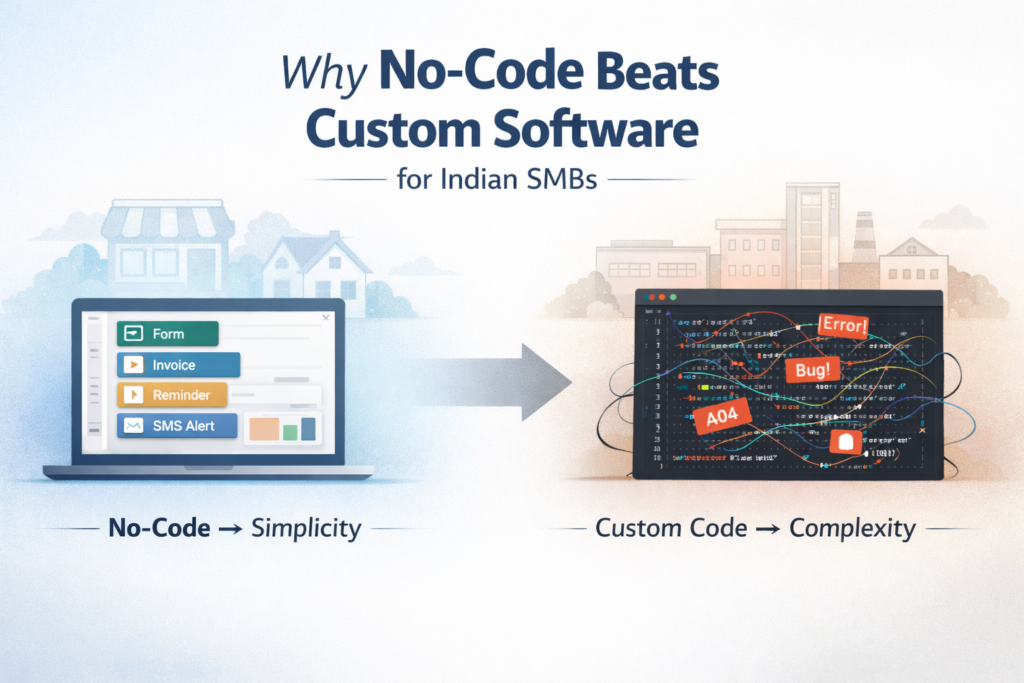
No-code gives you exactly what you need: speed, affordability, control, and simplicity.
Overview for simiplified understanding
| Feature/Factor | No-Code Platforms | Custom Software Development |
| Speed to Deploy | Days or weeks | Months or more |
| Cost | Low monthly subscription | High upfront development + maintenance |
| Technical Skill Needed | Minimal (drag-and-drop) | High (coding, debugging, testing) |
| Flexibility | High for common workflows | High for complex, unique needs |
| Maintenance Burden | Handled by platform | Handled by SMB or outsourced team |
| Scalability | Good for small to mid-size operations | Customizable for large-scale needs |
| Examples for Indian SMBs | Pharmacy alerts, school fee reminders, housing society billing | ERP, CRM, or niche industry tools |
At ProfitsPilotAI, we believe in empowering Indian business owners with tools that actually work for them. We help you navigate this no-code world so you can stop worrying about tech and start focusing on what you do best—growing your business.
If you are tired of waiting for developers or breaking the bank on software that doesn’t fit, it’s time to explore the no-code way. Your business deserves a solution that moves as fast as you do.